
Our honest verdict
Solid woodgrain aluminium avoids the combustible-core risk that put some ACP products at the centre of cladding rectification. For a timber look on a class 2-9 building, solid aluminium is the safer specification conversation.
What ACP actually is
Aluminium composite panel is two thin aluminium skins bonded to a core. Where that core is polyethylene (PE), the panel can carry significant combustible content - the issue behind well-known cladding fires and the subsequent rectification programs across Australia.
Fire-retardant (FR) and mineral-core ACP exists and performs far better, but the category as a whole now triggers careful scrutiny from certifiers and insurers.
Why solid aluminium is a cleaner story
Woodonali boards and battens are solid marine-grade aluminium, not a sandwich. The substrate is non-combustible to AS 1530.1, so there is no combustible core to assess. For a design team that wants a warm timber facade without re-opening the ACP debate, that is a meaningful simplification.
Where ACP still appeals
Flat composite panel can achieve very large, perfectly flat sheet faces and a broad solid-colour palette economically. If the brief is a large monolithic flat skin rather than a timber look, ACP (in a compliant core) remains a common choice. For a genuine timber aesthetic, sublimated solid aluminium is the better fit.
The two contenders
Woodgrain aluminium
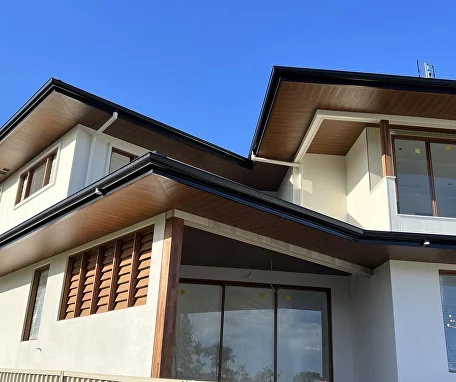
Solid marine-grade aluminium with a sublimated woodgrain coat. Non-combustible substrate, holds its day-one colour, and needs only an occasional wash - no oiling, no recoating.
Composite / ACP
Both are aluminium-faced. The difference is what sits in the middle - and that matters for fire.
At a glance
Side by side on the points that decide most projects.
| Factor | Woodgrain aluminium | Composite / ACP |
|---|---|---|
| Construction | Solid aluminium board/batten | Two skins over a bonded core |
| Fire risk | No combustible core | Depends on core (PE vs FR vs mineral) |
| Certifier scrutiny | Straightforward non-combustible substrate | Heightened post-rectification scrutiny |
| Timber look | Sublimated woodgrain | Mostly solid colours; limited grain |
| Best use | Timber-look facades, battens, soffits | Large flat solid-colour sheet faces |
The Woodonali product
Compliant, timber-look facade systems for homes and commercial buildings - non-combustible aluminium that delivers the architectural warmth of timber at scale.
Get a real comparison for your project
Send your elevations or rough areas and we will price the woodgrain aluminium option in AUD, so you can compare it against the alternative on the numbers that matter to you.
Other comparisons
Woodgrain Aluminium Cladding vs Natural Timber Cladding
The look is close; the lifecycle is not. Here is where each material genuinely wins.
Compare ›
Woodgrain Aluminium vs Fibre Cement Cladding
Fibre cement is the value workhorse; aluminium is lighter and carries a more convincing timber grain.
Compare ›
Woodgrain Aluminium vs Vinyl (PVC) Cladding
Vinyl is cheap and easy; aluminium is non-combustible and holds up far better under Australian sun.
Compare ›
Woodgrain Aluminium vs Colorbond Steel Cladding
Two non-combustible metals with different jobs: steel for crisp solid-colour profiles, aluminium for a warm timber look.
Compare ›
Woodgrain Aluminium vs Brick or Rendered Walls
Masonry is the durable base; woodgrain aluminium is the warm face you add over or beside it.
Compare ›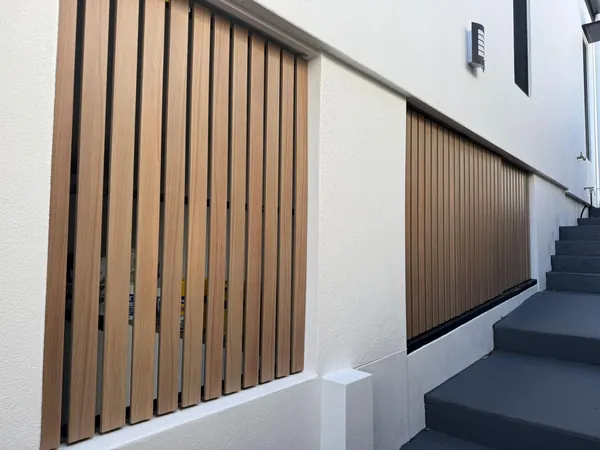
Aluminium Battens vs Timber Battens
Same linear look; very different behaviour once the sun and rain get to them.
Compare ›Planning a woodgrain aluminium project?
Talk to our Australian team for obligation-free advice, samples and pricing in AUD.